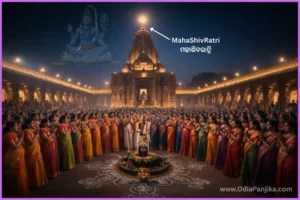
1. What is MahaShivratri?
Maha Shivratri is a famous Hindu festival. It is celebrated by millions of people. The name comes from three words:
- Maha: This means “Great.”
- Shiv: This is the name of the God.
- Ratri: This means “Night.”
So, the name means “The Great Night of Lord Shiva.” Most Hindu festivals happen during the day, but this festival is special because it happens at night. It is a time for prayer, fasting, and staying awake to honor Lord Shiva.
2. When is it Celebrated?
This festival comes once every year. It follows the lunar (moon) calendar.
- Month: It falls in the month of Phalguna. On the English calendar, this is usually in February or March.
- The Day: It is observed on the 14th day of the dark half of the moon cycle. This day is called Krishna Paksha Chaturdashi.
- The Difference: There is a “Shivaratri” every month, but this one is the “Maha” (Great) one because it is the most powerful night of the year.
3. Who is Lord Shiva?
To understand the festival, we must know about Lord Shiva. In Hinduism, there are three main Gods called the Trimurti:
- Brahma: The Creator.
- Vishnu: The Protector.
- Shiva: The Transformer or Destroyer of Evil.
How does Shiva look?
Lord Shiva is shown as a very simple God. He does not wear gold or fancy clothes.
- Mount Kailash: This is his home in the Himalayas.
- Matted Hair: His hair is long and tied up. The River Ganga flows from his hair.
- The Third Eye: He has an extra eye on his forehead. It represents wisdom and power.
- The Snake: He wears a cobra around his neck. This shows he has control over fear and death.
- Trishul (Trident): He holds a three-pointed spear. It represents the three powers: Will, Knowledge, and Action.
- Damru (Drum): He holds a small drum. The sound of this drum created the universe.
- Bholenath: People call him this name because it means “Innocent Lord.” He is very easy to please with simple prayers.
4. Why do we celebrate this night?
There are four main reasons why this night is considered holy:
The Divine Marriage
Many people believe that on this night, Lord Shiva married Goddess Parvati. It is a celebration of the union of power and nature. In many temples, people perform a wedding ceremony for the Gods.
The Churning of the Ocean
Long ago, the gods and demons churned the ocean to find nectar for long life. But first, a deadly poison called Halahala came out. It was so strong it could burn the whole world. Lord Shiva drank the poison to save everyone. He kept it in his throat. His throat turned blue. Because of this, he is called Neelakantha (The Blue-Throated One).
The Cosmic Dance
Some believe Shiva performed the Tandava dance on this night. This is a dance of rhythm, creation, and destruction. It keeps the universe moving in balance.
The Pillar of Light
A story says that Lord Shiva appeared as a giant pillar of fire (Jyotirlinga). Brahma and Vishnu could not find the top or bottom of this light. This proved that Shiva is infinite and has no end.
5. Main Rituals: What do People do?
The festival has a very clear set of rules that people follow with devotion.
Fasting (Upavasa)
Fasting is the most important part.
- Why? It cleans the body and mind. When the stomach is empty, it is easier to focus on God.
- Types: Some do a “Full Fast” with no food or water. Others eat fruits or drink milk. This is called “Phalar.”
- Discipline: It teaches self-control. It shows that the spirit is stronger than hunger.
Staying Awake (Jagaran)
Devotees do not sleep at night. They stay in temples or pray at home.
- Why? It represents being “awake” to the truth. It means we should not live in the darkness of ignorance.
- The Four Prahars: The night is divided into four parts. Every three hours, a new prayer starts. Devotees perform Abhisheka (bathing the Lingam) in all four parts.
Chanting Mantras
The most famous mantra is “Om Namah Shivaya.” * Meaning: “I bow to Lord Shiva.”
- Method: People use beads (Rudraksha Mala) to count. They chant it 108 times or more. This sound creates peace in the brain.
6. Worship of the Shiva Lingam
The Shiva Lingam is a symbol of Lord Shiva found in every temple. On this day, people offer six special things to the Lingam:
- Water: To represent purity and a cool mind.
- Milk: For a healthy and long life.
- Honey: For sweet speech and kindness.
- Curd: For prosperity and wealth.
- Ghee: To remove bad thoughts.
- Bel Patra (Bilva Leaves): These are three-leafed branches. Shiva loves these leaves. Offering them brings good luck.
7. Maha Shivaratri in Odisha
In our state, Odisha, the festival is very big.
- Lingaraj Temple: This temple in Bhubaneswar is the center of the festival. Thousands of people wait in lines.
- The Mahadipa: This is a very large lamp. Priests carry it to the top of the temple at midnight.
- Breaking the Fast: In Odisha, most people wait to see the Mahadipa before they eat any food. It is a very emotional and happy moment.
8. The Spiritual and Scientific Meaning
Spiritual Meaning:
The festival is about removing “darkness.” Darkness means anger, greed, and ego. Light means knowledge and love. By praying to Shiva, we try to become better human beings.
Scientific Meaning:
Scientists and yogis say that on this night, the energy of the Earth moves upward. If a person stays awake with a straight spine, it helps their physical and mental health. It is a natural time for the body to heal and grow.
9. Simple Home Puja (How to do it)
You do not need to go to a big temple to celebrate. You can do it at home:
- Clean your house.
- Take a bath early in the morning.
- Wear clean clothes (white is a good color).
- Place a small idol or photo of Lord Shiva.
- Light a lamp (Diya) and some incense sticks (Agarbatti).
- Offer a glass of milk or water.
- Sit quietly and chant “Om Namah Shivaya” for 10 minutes.
- Do not say bad words or get angry during the day.
10. Food After the Fast
Once the sun rises the next day, the fast is broken.
- People eat simple food like Sabudana Khichdi, boiled potatoes, or peanuts.
- They avoid heavy grains like wheat or rice during the fast.
- This helps the stomach start working slowly again.
11. Important Lessons from Lord Shiva
Lord Shiva is a role model for a simple life.
- Simplicity: He is the God of gods, but he lives in a forest and wears simple skin. He teaches us that we do not need expensive things to be happy.
- Equality: He accepts everyone. He stays with ghosts, animals, and humans. He teaches us not to judge people.
- Calmness: Most of the time, Shiva is in deep meditation. This teaches us to keep our minds calm even when life is difficult.
12. Conclusion
Maha Shivaratri is a beautiful night. It is a gift for our soul. It reminds us that even in the darkest night, there is a light within us. Whether you fast, pray in a temple, or just sit quietly at home, the goal is the same: Peace, Purity, and Devotion. It is a time to celebrate our culture and connect with the Divine.